
How to Check a Community Takeover Coin Before Buying
The developer left. Before you trust the comeback, check the receipts.
- ·The story
- ·What is a community takeover coin?
- ·Does a community takeover mean a coin cannot be a rug pull?
- ·How do I know I have the real token contract?
- ·Who holds the supply, and why does that matter?
- ·Is the liquidity locked, and can it be removed?
- ·Why might I be able to buy a coin but unable to sell?
- ·What does burning FOMOEgg actually do?
- ·How can I verify a token burn myself?
- ·Is burning half the supply a promise?
- ·Where can I find FOMOEgg and ask questions safely?
- ·Check a claim
- ·Sources
The developer left. Before you trust the comeback, check the receipts.
A community can keep building, but a good story still needs proof.
FOMOEgg’s story is about holders taking on that work. For anyone arriving now, the useful question is simple: what can I check for myself? Here is a practical way to read a CTO project, using public records and clear limits.

5 checks before you trust a takeover
What is a community takeover coin?
A community takeover, or CTO, is when a community takes on work once led by a token’s original developer. The label alone does not prove that contract powers, website access or project controls have changed.
A community takeover, or CTO, is when a community takes on work once led by a token’s original developer. The label alone does not prove that contract powers, website access or project controls have changed.
For FOMOEgg, the published roadmap describes the original developer going quiet and the community rebuilding. It records the takeover switch on October 14, 2026. Start with the takeover proof, then ask what changed and what stayed the same. A new team cannot erase old token holdings or the risks built into a contract.

Does a community takeover mean a coin cannot be a rug pull?
No. A takeover is a claim about who is doing the work, not a safety certificate. A token can still carry risks from concentrated holdings, removable liquidity or harmful contract rules.
No. A takeover is a claim about who is doing the work, not a safety certificate. A token can still carry risks from concentrated holdings, removable liquidity or harmful contract rules.
Look for records that support each claim. Can the team show completed work? Can readers ask hard questions in public? Does the evidence match the contract being traded? Our rug-pull guide is a starting point. Missing evidence is a reason to pause, even when the community sounds welcoming.
How do I know I have the real token contract?
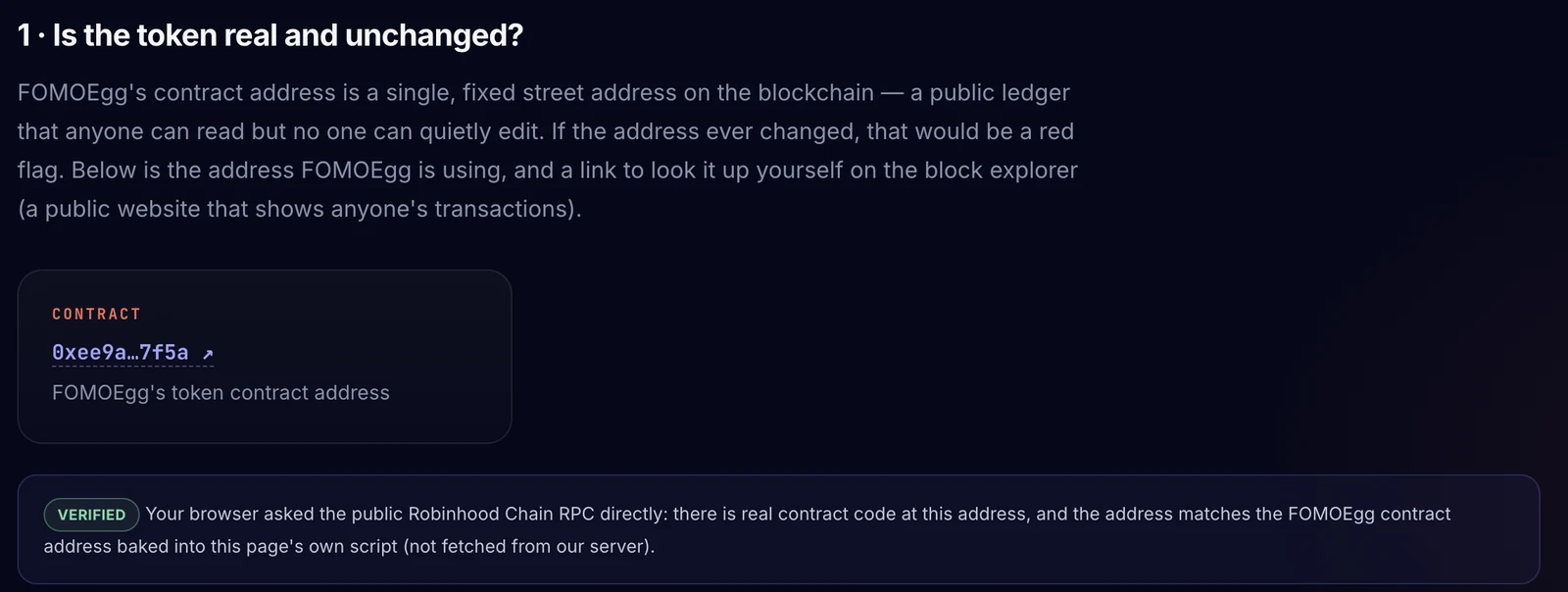
Compare the full contract address across the project’s verification page and the correct chain’s explorer. A matching name, logo or ticker does not establish that you found the same token.
Compare the full contract address across the project’s verification page and the correct chain’s explorer. A matching name, logo or ticker does not establish that you found the same token.
For FOMOEgg, begin at Verify and follow its explorer link. Check the network as well as the address before using an app. Robinhood describes its chain as open and permissionless; being on that network does not mean a community token is approved by Robinhood. FOMOEgg is a separate community project, with no Robinhood affiliation.
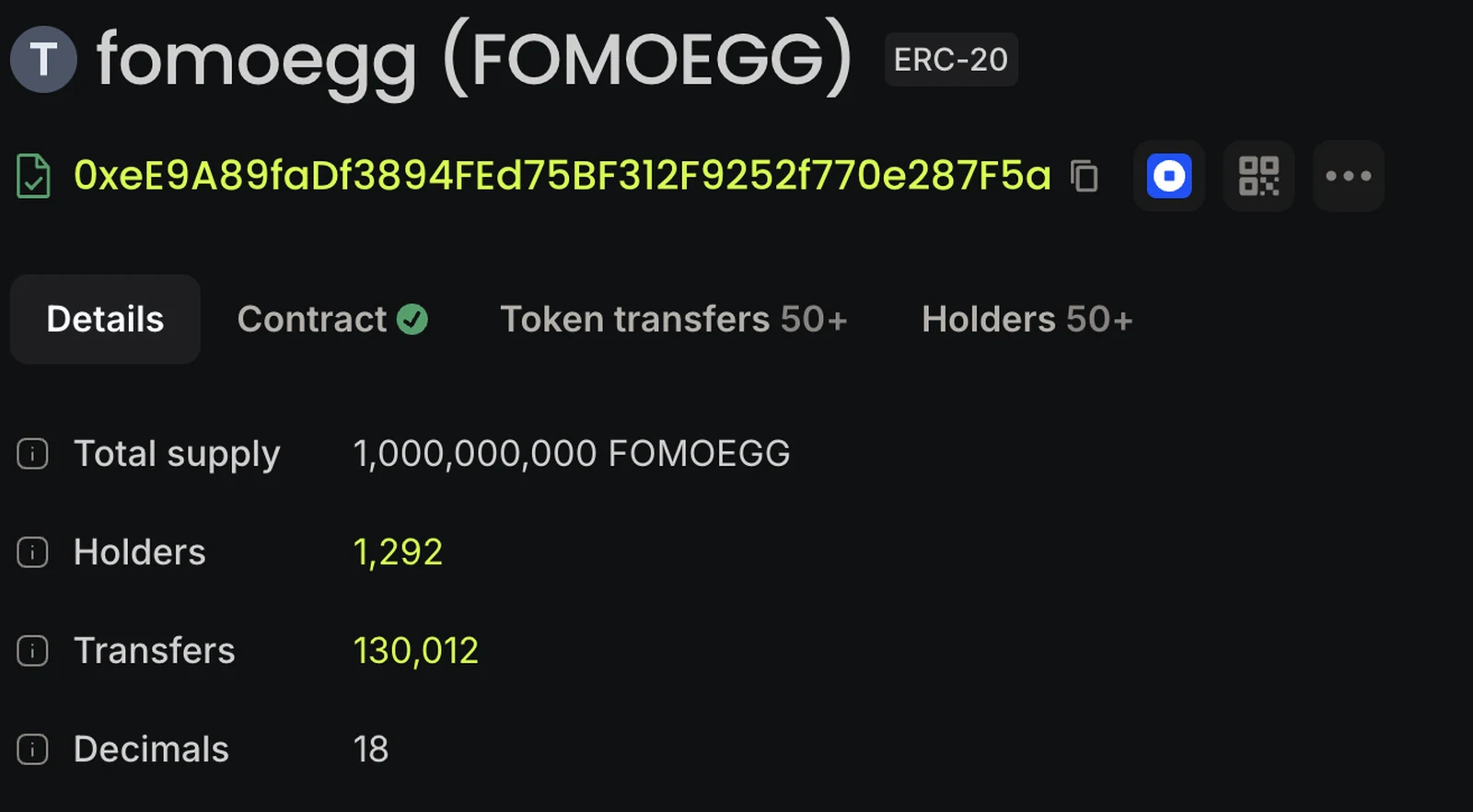
Who holds the supply, and why does that matter?
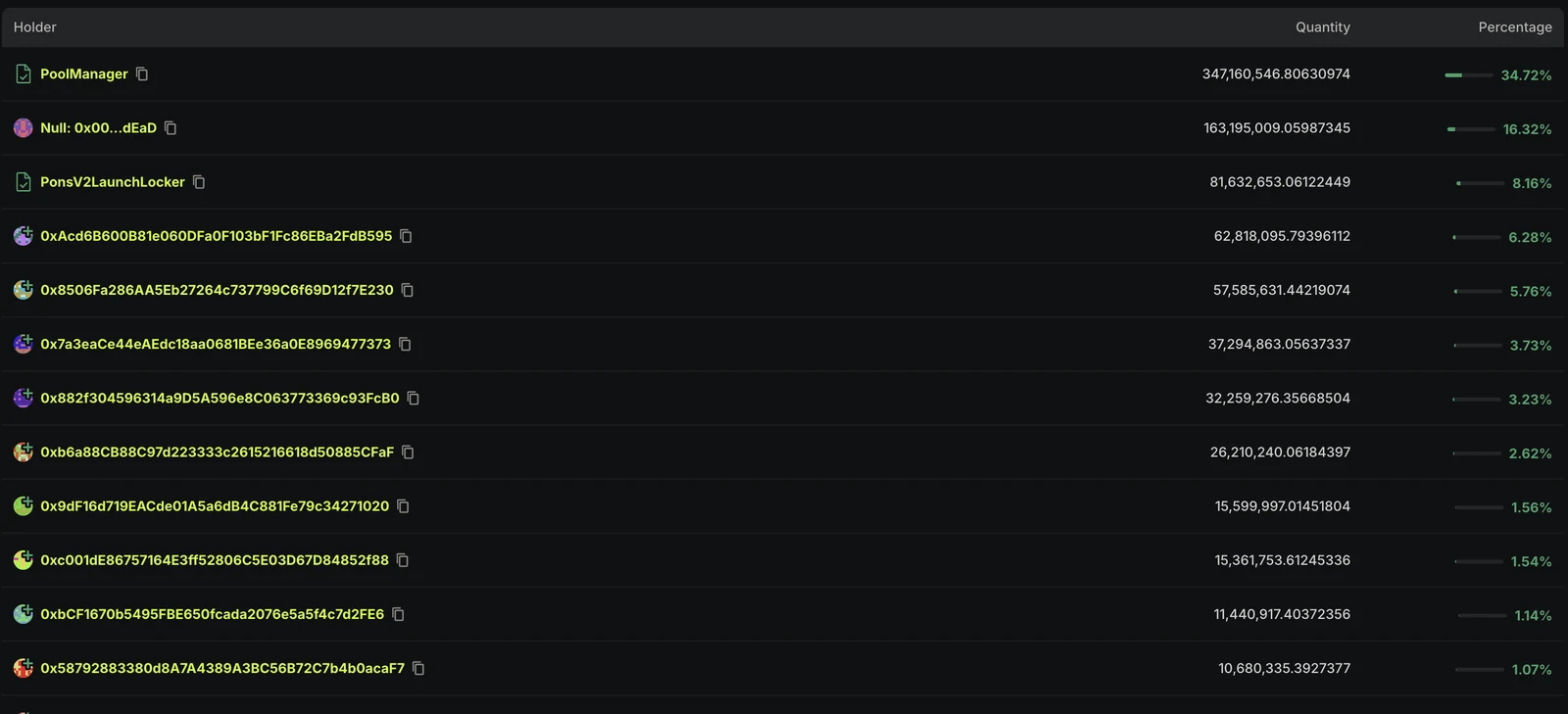
Check the holder list, then identify which entries are people, pools, contracts or the dead address. Large private holdings can create selling pressure, while a pool or dead-address entry needs a different reading.
Check the holder list, then identify which entries are people, pools, contracts or the dead address. Large private holdings can create selling pressure, while a pool or dead-address entry needs a different reading.
An address is not the same as a person. One person can use several addresses, and a service can hold tokens for many people. FOMOEgg’s tokenomics section explains that its largest-address list includes the pool and burn address. This article makes no claim about the current share held by private holders; check the live records rather than guessing from a headline.
Who holds the supply
- PoolManager · liquidity pool34.72%
- Dead address · burned16.32%
- PONS launch locker8.16%
- Nine other visible wallets26.93%
- Everyone else · remainder13.88%
The screenshot shows nine other wallets, not ten. Their combined share is 26.93%; the unseen tenth wallet remains in “everyone else.” Shares are calculated from the displayed token quantities. This earlier holder snapshot differs from the later burn snapshot.
Is the liquidity locked, and can it be removed?
A liquidity lock must be checked against the actual pool and its control records. Ask who can withdraw liquidity and, if there is a lock, when it ends and what it covers.
A liquidity lock must be checked against the actual pool and its control records. Ask who can withdraw liquidity and, if there is a lock, when it ends and what it covers.
A screenshot saying “locked” is not enough. Match the pool to the token, read the lock or position details, and check any limits. This article does not establish a current FOMOEgg liquidity lock, so it does not claim one. Uniswap’s scam guide explains how removed liquidity can leave holders unable to sell.

Why might I be able to buy a coin but unable to sell?
A sale can fail because liquidity is too low, the quote changes, the network has trouble or the token blocks selling. These causes are different, so an error message alone does not prove which one applies.
A sale can fail because liquidity is too low, the quote changes, the network has trouble or the token blocks selling. These causes are different, so an error message alone does not prove which one applies.
Check the token’s contract rules, pool activity and the app’s own support information. Do not keep raising slippage without understanding the failure. Fomo’s published terms describe low liquidity and network issues among trading risks. Its app listing is a place to inspect a token, not a guarantee that every trade will work.
What does burning FOMOEgg actually do?
FOMOEgg describes burns as transfers to the dead address, taking those tokens out of spendable circulation. Burning does not create demand or guarantee a market outcome.
FOMOEgg describes burns as transfers to the dead address, taking those tokens out of spendable circulation. Burning does not create demand or guarantee a market outcome.
On-chain data records 164.27 million tokens burned as of October 26, 2026, 04:22 UTC, roughly 16.4% of the original 1 billion supply. This is a historical snapshot, not a live counter. Sending tokens to a dead address also need not reduce the contract’s totalSupply value. Keep the original supply, dead-address amount and spendable tokens separate when reading a chart.
As of November 4, 2026, the burned total is 165,715,222 FOMOEGG, 16.57% of supply.
Every burn on chain
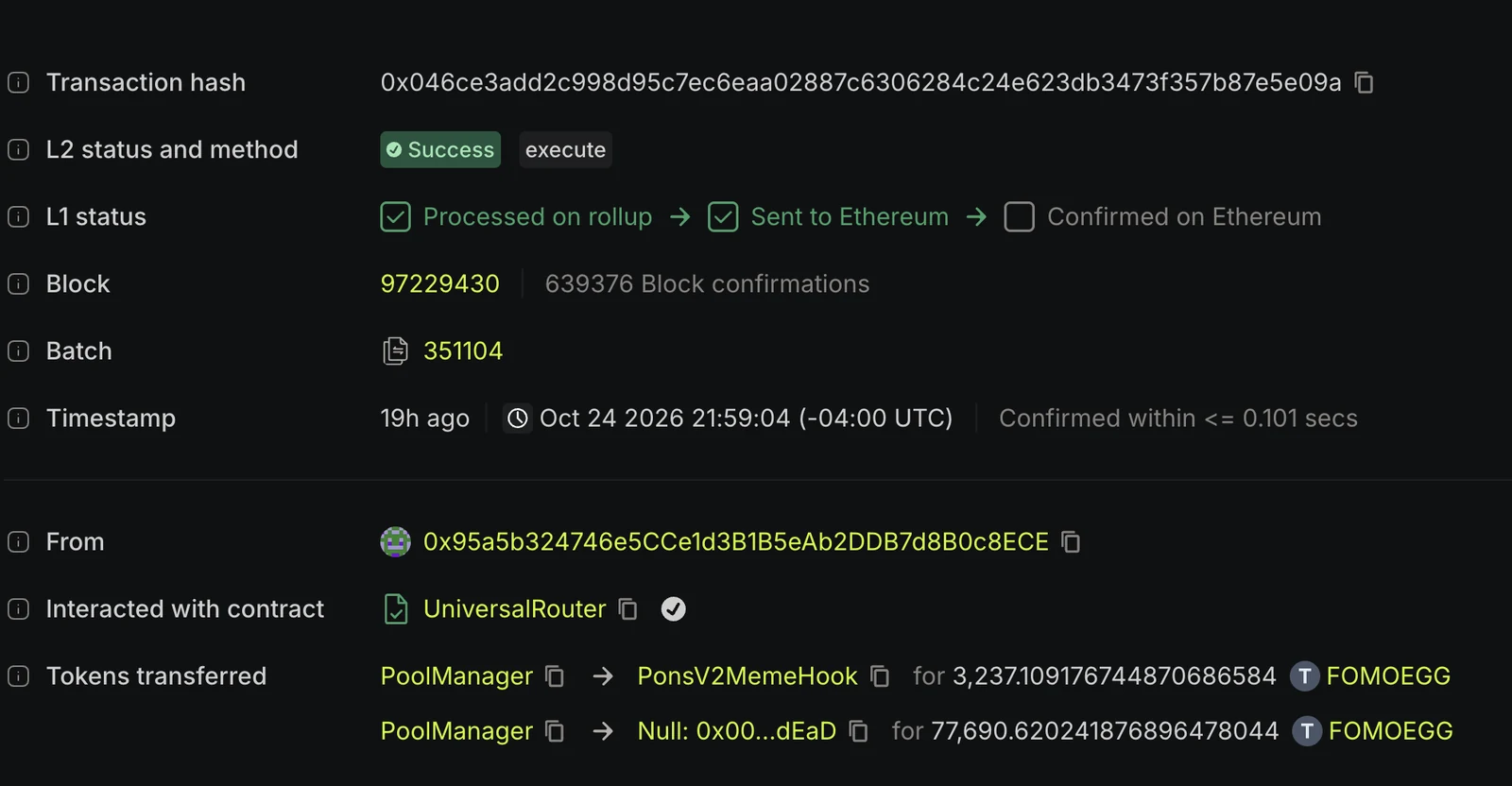
The window adds up to 13.70M tokens, starting from zero here; it is not the lifetime total. Highlighted receipt: 1,023,222.4020736032 tokens, Oct 25, 2026 EDT.
How can I verify a token burn myself?
Open the transfer on the correct chain’s explorer and confirm the token contract, destination, amount and transaction status. Then compare it with the dead address’s holdings for that same token.
Open the transfer on the correct chain’s explorer and confirm the token contract, destination, amount and transaction status. Then compare it with the dead address’s holdings for that same token.
A posted transaction hash is a useful lead, but you still need to open it. A failed transaction does not prove tokens moved, and a transfer of another token does not count. Follow the burn-verification lesson and start from the public verification hub. Viewing public chain records does not require a wallet signature.
Is burning half the supply a promise?
No. FOMOEgg’s community burn target is 500 million tokens, half the original supply. It is a target, with no guaranteed completion date or market outcome.
No. FOMOEgg’s community burn target is 500 million tokens, half the original supply. It is a target, with no guaranteed completion date or market outcome.
Use the calculator to explore assumptions, then compare them with recorded burns. A model shows what could happen if its inputs hold; it does not show what will happen. Check the roadmap for completed work and planned steps. Progress should be measured through receipts rather than a schedule the community cannot guarantee.

Burned so far vs the 500M target
Where can I find FOMOEgg and ask questions safely?
Start at the official FOMOEgg site and use its links to the Fomo token page and community Telegram. Compare the contract before any trade, and never share a seed phrase or private key.
Start at the official FOMOEgg site and use its links to the Fomo token page and community Telegram. Compare the contract before any trade, and never share a seed phrase or private key.
The Fomo app lesson explains the starting steps. For questions, use t.me/fomoeggcto and ask the CTO team for public evidence. Treat unexpected private messages and requests to sign a “verification” transaction with care. You can read, check records and help improve the project without buying tokens.
One small lesson: match the claim to the proof
Pick one claim, such as “tokens were burned.” Open its chain record and check what it shows. That record can prove a transfer; it cannot prove the team’s future plans or how the market will behave. Repeat that habit for each claim.
Want to join the burn effort? Begin by checking a receipt or helping someone understand it. Bring a question to the community, compare the evidence, and help keep the record clear.
Sources and dated records
- FOMOEgg roadmap and tokenomics
- FOMOEgg verification hub
- FOMOEgg takeover records
- Robinhood’s network explanation
- Uniswap: unsellable token scams
- Fomo trading terms
- Ethereum wallet security
Burn snapshot: October 26, 2026, 04:22 UTC. Holder screenshot: October 25, 2026. Original research checked October 25, 2026. See the linked records for current data.