FOMOEgg · Field notes
Burn, Believe, Write the Thesis: FOMOEgg 101
Check the burn. Understand the community. Put your reasons into words.
Full story selected
Our story: the community stayed
165,144,458 FOMOEgg burned. 16.51% of the original billion. That is the dated October 30, 2026, 16:41 UTC reading. Start with a number you can check, then meet the people keeping the story moving.
As of November 4, 2026, the burned total is 165,715,222 FOMOEGG, 16.57% of supply.
The original creator left. The community took over. PONS approved the takeover on September 25, 2026; the on-chain transition followed on October 14. The same egg continued, with people stepping forward to do the daily work.
Burns keep running. The Egg Race runs once a day. The lessons are free. A newcomer can read the takeover record, inspect the contract and ask a direct question without first becoming an expert.
A community takeover means taking responsibility after the original team steps away. The practical work is ordinary: keep the information current, answer questions, explain unfamiliar terms and make completed work easy to find. A label becomes useful when someone can follow it to evidence.
That is why this story starts with FOMOEgg itself. The supply record, race schedule and learning pages give the conversation something solid. You do not have to accept a stranger's enthusiasm as your research. You can open the same records and form your own view.
The chart adds another part of the history. This egg has already attracted a busy crowd. It has also experienced a sharp collapse. Both belong in the story, alongside the community's work since then.
Project chronology: takeover proof and October announcement. Supply: public reading, cross-checked against the chain.
The Egg Race is only for people in places where it is allowed. It is void where prohibited by law. Check your local rules before you take part. Free to enter, no purchase needed. English rules control.
The chart: what real attention looked like
September 20: $1.91 million traded in a single day. At its launch-day high, the egg touched about $876K (price × 1 billion original supply). That is what real attention looks like on this chart.



Then the original creator walked away. Within four days the chart was down about 98%. Most coins end right there.


Zoom in on launch day and you can see the rush hour by hour: tall candles, and volume bars towering over everything that came after.
The community didn’t walk away. The chart bottomed around October 9 at about $10.7K. By October 30 it was $19.7K, up about 85%, with burns running and the race going once a day.


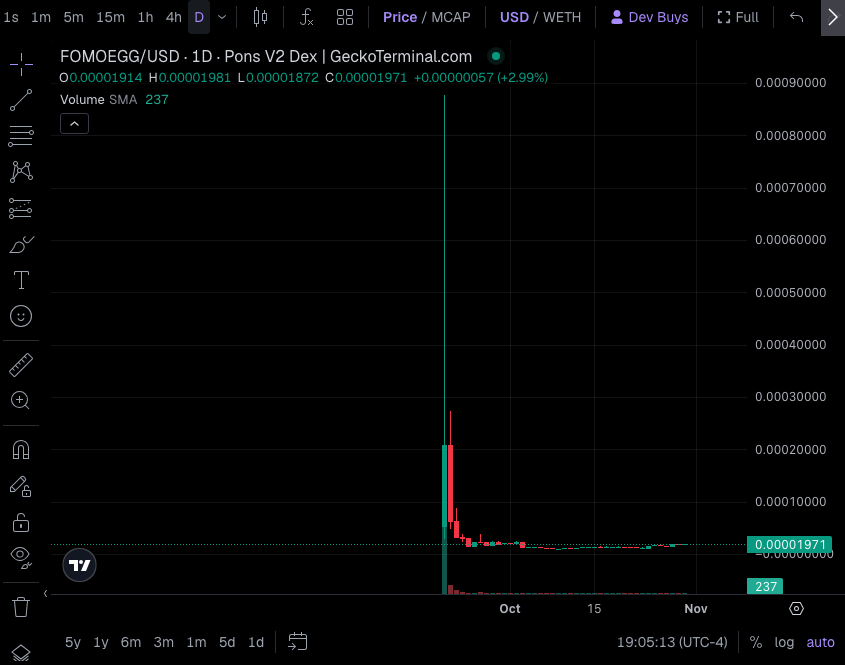
The egg has already shown what a crowd can do. Now the community is rebuilding the base: burns, free lessons, a working race and honest answers for anyone new.
That's history, not a promise. Not financial advice.
Source: GeckoTerminal pool OHLCV, daily and hourly readings, October 30, 2026. The current UTC day is incomplete. One pool's observed history is the scope of these charts.
The burn: make the number checkable
Fixed supply. Every burn makes each remaining egg a bigger share of the whole. Here, the whole means the usable supply after removal. Start with one billion original tokens, remove some permanently, and the tokens still available represent a larger share of what remains.

A burn is a permanent removal from use. One method sends tokens to an unspendable address. Another destroys them through the token's own code. FOMOEgg's public counter measures tokens at the dead address and subtracts them from the original billion. The on-chain token record remains the place to verify the amount.
The panel provides a convenient reading and a timestamp. If a fresh reading cannot be verified, it keeps a dated fallback visible. When checking it yourself, compare records from the same time. A moving live counter and an earlier article snapshot can both be accurate.
Read Blockscout in five steps
- Open the right network. Use Robinhood Chain's Blockscout explorer. Start from the project's verified links and match the full FOMOEgg contract:
0xee9a89fadf3894fed75bf312f9252f770e287f5a. - Open the dead address. Match all of
0x000000000000000000000000000000000000dEaD. The screenshot below shows the actual address header, so you know what you are looking for. - Find the correct token. In the token list or token transfers, select FOMOEgg and compare its contract with the one above. Similar names do not establish identity.
- Open a transfer. Check the destination, token amount, successful status and UTC time. A successful transaction with the wrong token or destination does not establish this burn.
- Compare the cumulative reading. The amount at the dead address is cumulative; a recent transfer is one contribution to it. Do not add the same transfer twice when following it across pages.

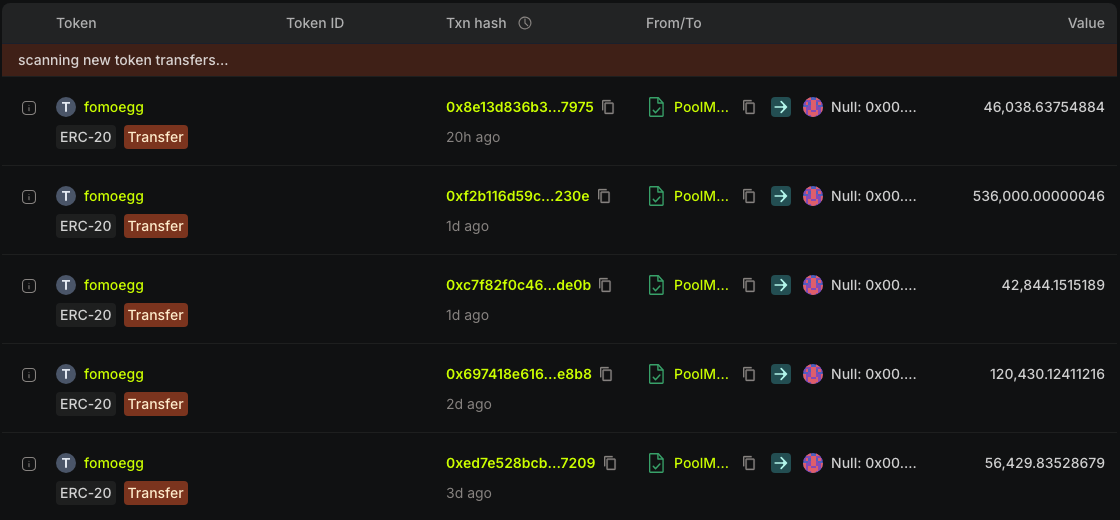
You can read these records without connecting a wallet. Keep the transaction link and the time you checked it. Those two details make a question much easier for another person to answer. They also let you revisit the evidence after the conversation moves on.
Burns don't guarantee price. Supply is one part of a market; demand, liquidity and selling still matter. A rising burn total answers a supply question. It does not answer every question about the token.
Three well-known burn histories
SHIB introduced a burn portal in April 2022. Contemporary Decrypt reporting described more than eight billion SHIB removed in its first 24 hours; another April 25 account reported about eleven billion after the portal had been running longer. The dates and windows explain why the numbers differ.
BNB's 37th quarterly burn, announced October 19, 2026, removed 1,646,196.44 BNB. The announcement and program tracker give readers a dated event and a place to inspect the program. A scheduled program and a voluntary token transfer use different mechanisms, even when both are called burns.
Ethereum introduced EIP-1559 burning with the London upgrade in August 2021. CoinGecko's August 2024 study counted 4.36 million ETH burned through August 5, 2024. The official issuance guide explains why new issuance can still offset removal. These are dated examples of supply mechanics, not comparable token outcomes.
Burns inside a takeover story
FOMOEgg is the example you can investigate here: its takeover chronology and dead-address record are separate pieces of evidence. Read both. The cumulative burn total describes the token's history; the takeover dates describe when the community assumed responsibility.
A second historical comparison is ANARCHY on Solana. Its CoinGecko description and a December 2024 community account describe a creator stepping away after a 55% supply burn. That is an attributed account of a launch burn, rather than an independently audited ongoing CTO burn program. The distinction matters when comparing it with FOMOEgg's continuing records.
The best habit across all these examples is simple: ask what was removed, on which network, by what method and at what time. A large number becomes informative when those questions have answers.
Early believers leave a record

History rewards the people who arrive early and keep showing up. The people who got the most out of these communities did more than notice a name. They learned the tools, made connections, explained the project and helped build the reasons others stayed.
Dogecoin's own history records community organizing in 2014, including clean-water work. CoinDesk's March 2017 account looks back at the tipping culture and practical initiatives. Showing up meant using the token socially and turning a shared identity into organized action.
SHIB's April 2022 portal is another concrete example. A community idea became an interface that people could use and a removal record that others could inspect. The useful lesson is participation made visible: someone explained the process, someone built the page and someone checked the result.
Takeover communities add a different kind of persistence. Billy's July 2024 reporting describes members continuing after the developer departed. Binance Academy's Neiro explainer describes another community-led token history. Their existence shows what continuity looks like, without turning every abandoned token into the same story.
For FOMOEgg, early participation is practical right now: read the proof, try a free lesson, understand how the race works and help another newcomer find an answer. You can contribute a useful explanation before you know every technical term. You can also notice a confusing page and suggest a correction.

The strongest form of conviction can explain itself. It can name the evidence, admit a mistaken reading and return with a clearer answer. Staying involved should deepen your understanding. It should never require pretending that new information does not exist.
Fomo: discovery with a public reason attached

Fomo puts phone trading, trader follows and written theses close together. You can discover a token, read what someone thinks about it and decide whether their reasoning deserves more investigation. A public thesis gives a fast conversation something you can revisit.
FOMO Labs Inc. operates the app. In its June 22, 2026 announcement, Fomo reported more than 600,000 users, over $4 billion in trading volume and a $75 million Series B led by Index Ventures. Dealroom's June interview summary reported the same milestones. These are historical company-reported figures, not October active-user counts.
A practical public walkthrough
Begin with Fomo's official site and its own help pages. Open the token you are researching and check its network and contract. Read the asset information before deciding whether to proceed. A name or familiar picture is only the start of identification.
If you choose to buy, inspect the asset, amount and order preview before confirming in the app. Pause whenever something is unclear. The point of a simple interface is to make the steps understandable; your reason for taking those steps still needs to be your own.
Follow traders whose explanations you want to examine. Compare what they wrote with the evidence they linked and their later updates. Following helps you discover ideas; it does not make another person's decision suitable for you. Keep discovery and your own decision as two distinct steps.
Fomo's public thesis guide says you can write from a token page when you have a position, or during the purchase flow. A position is attached to the thesis. GMGN's guide to Fomo calls independently documents the connection between the written view and a visible position.
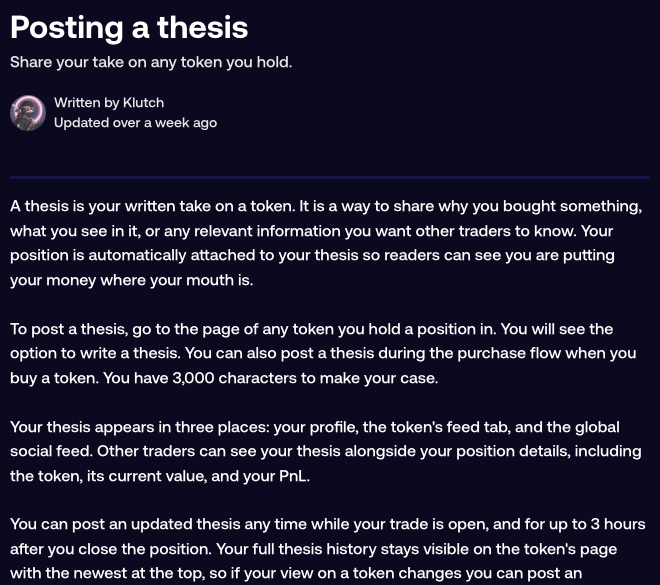
The app's public guide also explains updates and thesis history. That makes the second explanation as important as the first: readers can see how a view developed. Fomo's October release notes and newsletter archive describe continuing work on discovery and thesis translation.
FOMOEgg is an independent community token you can find on Fomo through the project's linked token route. The full contract remains your reference when checking it. The shared name is a useful conversation starter; the community's work supplies the substance of its own story.
Write five lines. Then keep them current.
A thesis forces you to know why you hold. It gives you something to review on a red day and builds a public track record people can read. Its strength comes from clarity: what you believe, what supports it and what would change your mind.
The five-line card is an editorial worksheet. Start with the observation, attach evidence, choose a visible milestone, name the weak point and set a review date. Keep the statement small enough that another reader can check it. Replace broad praise with a specific reason.
Example: a FOMOEgg research thesis
October 30, 2026. I am watching whether FOMOEgg turns its community takeover into sustained public work. I checked the September 25 approval account, October 14 execution record and dated supply reading showing 16.51% removed. Next I will check whether burn records, race information and lessons remain current. I would revise my view if those records became inconsistent or the work stopped. I will review the evidence again in a week and keep any participation within my own loss limit.
This example names observable work. It gives no price target and does not turn the launch spike into a future destination. Someone reading it can disagree with the interpretation while still finding the same records.
Example: a generic community-token template
I am researching this community because its completed work addresses a specific problem I understand. My evidence is a dated project record and a separate source I can open. The next milestone is a published result, with a date I will check. I would change my view if the result failed to appear or contradicted the original explanation. My review date and personal loss limit are written down before I act.
To update a thesis, return to the claim you actually made. Write what changed, attach the new source and explain whether your conclusion changed with it. Keep an unchanged view just as specific: say which new evidence still supports it. An update should help a reader understand your thinking without reconstructing an entire conversation.
Public writing is useful practice even before you trade. Draft your research note privately, check its links and ask whether it makes sense a week later. You can learn to reason clearly without rushing into a position.
Eight principles worth keeping

- Keep recovery words offline and private. Never send them to support, a chat admin or someone offering to fix an account. Learn what a recovery phrase controls before using a wallet. Read the lesson.
- Read every permission before signing. A familiar website design does not tell you what a request authorizes. Stop when the request does not match what you intended to do. Read the safety lesson.
- Match the full contract and network. Copy the identifier from verified project links and compare it with the asset page. A ticker and an egg picture can be copied. Learn the check.
- Understand slippage before a swap. The final execution price can differ from the preview as trading changes the pool. Check the setting and the expected result instead of increasing the setting just to force an order through. Read about slippage.
- Inspect token powers and restrictions. Research who can change the contract, create tokens or restrict transfers. A community takeover description does not answer those technical questions by itself. Study the warning signs.
- Check liquidity and price impact. A displayed price does not tell you how a particular order will execute. Compare your intended order with the available market and read the preview carefully. Learn the basics.
- Use only money you can afford to lose. Keep essential expenses outside a speculative decision and never borrow to participate. Choose your own limit before excitement makes the choice harder. Read about risk.
- Read original records and review your thesis. Check the source behind a screenshot, save the date and revisit your reasoning when facts change. A useful community welcomes precise questions. Build a research habit.
These habits reinforce each other. Correct identification makes the explorer check useful. A written reason gives your review a starting point. A personal limit gives you room to learn without allowing a fast conversation to make every decision for you.
For independent guidance, read MetaMask's security basics alongside Fomo's slippage explainer. Use the linked lessons as a learning sequence, then return to the actual records for the token you are researching.
Answers before you act
What is a token burn?
A burn permanently removes tokens from usable supply. Check the token contract, destination, amount and successful transaction on the correct network. The record matters more than a picture of a counter.
Do burns raise price?
Not guaranteed. Burns reduce usable supply, while demand, liquidity and selling also shape price. A burn total measures removal; it cannot tell you what the next trade will do.
What does the chart call market cap?
These charts use price × 1 billion original supply. That keeps the historical comparison consistent. It is a price-based reference, rather than an estimate adjusted for the tokens removed over time.
When was the community low?
October 9 closed near $10,651 on the original-supply measure. The lowest wick in the daily history was about $10,483 on October 8. The roughly 85% recovery uses the October 9 close and the latest October 30 reading.
What is the Fomo app?
Fomo is a social trading app operated by FOMO Labs Inc. It combines token discovery, trader follows and written theses. Read its official help pages to understand the current workflow.
What is a thesis on Fomo?
It is a written view with a token position attached. Explain your reason, the evidence and what would change your mind. The public help guide describes posting and updating it.
Can I update a thesis?
Yes. Fomo documents updates while a position is open and a short window after closing. Keep the new explanation tied to the original claim so readers can follow what changed.
How do I research FOMOEgg before buying?
Start with verified project links, match the full contract and network, inspect the token and liquidity, and read every request before signing. Write your reason and personal limit before deciding whether to proceed.
What is a CTO coin?
CTO means community takeover. Members continue the work after the original team steps away. Check its chronology, completed work and contract records separately; a tracker label does not establish all three.
Do I need a wallet to check a burn?
No. Public explorer records can be read without connecting a wallet. Open the token and transaction directly, compare the destination and save the link with the time you checked it.
Bring a question. Bring a source.

The burn is a record you can inspect. The chart is a history you can study. A thesis is an explanation you can challenge. A community becomes easier to understand when all three are available to newcomers.
Start with one small check: open a burn record, read a lesson or write five clear lines about what you learned. Then bring a useful question. The next person arriving will benefit from an answer they can follow.
Join the community to discuss the evidence, ask a beginner question or suggest a correction.
Memecoins can lose all their value. Not financial advice.
The egg, in two minutes
165,144,458 FOMOEgg burned. 16.51% of the original billion. That is the October 30, 2026, 16:41 UTC supply reading. You can open the public record and check it yourself.
As of November 4, 2026, the burned total is 165,715,222 FOMOEGG, 16.57% of supply.
The creator left. The community took over. PONS approval came September 25; the on-chain transition followed October 14. Burns keep running, the Egg Race runs once a day and the lessons are free.
The chart has a full story
Launch: September 20 brought $1.91 million in pool volume and a peak near $876K.
Collapse: by September 24's close, it had fallen about 98% from that peak.
Community recovery: October 9 closed near $10.7K. By October 30 it was $19.7K, up about 85%.
All chart values use price × 1 billion original supply. The true daily wick low was about $10,483 on October 8. The recovery comparison starts from October 9's close.
That's history, not a promise. Not financial advice.
Early means showing up
Dogecoin's early community organized real projects in 2014. SHIB's community built around a burn portal in April 2022. The useful lesson is participation: learn the tools, explain the evidence and help the next person understand.
For FOMOEgg, that work is happening now. Read a burn record, try a lesson or follow the race. A small community gives a useful contribution room to matter.
Give your view a reason
Fomo combines phone trading, trader follows and public theses. A thesis forces you to explain why you care, what you checked and what would change your mind. Write five lines before following a fast conversation.
Example: I am watching whether FOMOEgg keeps its public work current. I checked the takeover dates and supply reading. Next I will review the burn records, race and lessons. Inconsistent evidence would change my view. I will review again in a week.
Keep three basics
- Keep recovery words private. Read every permission.
- Match the full contract and network. Check liquidity and slippage.
- Use only money you can afford to lose. Review your own reasons.
Start with the free lessons, then bring one clear question and a source to the conversation.
Build the next useful answer
Join the community to learn, ask questions and help make the evidence easier to understand.
Burns don't guarantee price. Memecoins can lose all their value. Not financial advice.